
This article is for information only — not medical or legal advice.
What Is DMT? The Basics
DMT — N,N-dimethyltryptamine — is a naturally occurring psychedelic compound found in dozens of plant species, in some animals, and in trace amounts in the human body itself. It belongs to the tryptamine family, making it a close chemical cousin of serotonin and melatonin, two molecules central to how the brain regulates mood and sleep.
When consumed in sufficient amounts, DMT produces one of the most intense — and shortest-acting — psychedelic experiences known. Humans have used DMT-containing plants for centuries, most famously in ayahuasca, the ceremonial brew of the Amazon basin. In its modern extracted form, DMT typically appears as a crystalline material that is vaporized for effect.
The simplest accurate summary: DMT is a powerful, fast-acting, naturally occurring psychedelic with a long history of traditional use and a short history of modern scientific study.
Why Is DMT Called the Spirit Molecule?
The nickname “spirit molecule” traces to a specific source: Dr. Rick Strassman’s 2001 book DMT: The Spirit Molecule, which recounted his clinical research at the University of New Mexico in the 1990s — the first sanctioned human psychedelic research in the United States in more than twenty years.
Volunteers in Strassman’s studies, given intravenous DMT in a hospital setting, repeatedly described astonishingly similar experiences: being transported to otherworldly realms and encountering seemingly intelligent, autonomous entities. Strassman, a psychiatrist approaching the work as a scientist, found himself grappling with volunteers’ insistence that what they’d encountered was real — a tension that gives the book its enduring fascination.
The name stuck far beyond the lab. “Spirit molecule” is now the most widely recognized popular nickname for DMT, appearing in documentaries, podcasts, and everyday conversation. When you see the phrase, it almost always refers to DMT — and to the strange consistency of what people report experiencing on it.
What Is in DMT? Chemistry and Composition
At the molecular level, the question of what is in DMT has a clean answer: a single compound, N,N-dimethyltryptamine. It’s a structurally simple tryptamine — its shape closely resembles serotonin, which is precisely why it binds to serotonin receptors in the brain and produces its effects. There’s no mystery ingredient; DMT is DMT.
A related but different question is what people mean when they ask what’s in a DMT vape product. In general terms, a DMT vape liquid contains DMT extract suspended in a carrier liquid formulated to vaporize cleanly when heated by the device’s coil. The exact formulation — the ratio, the carrier, any additional ingredients — varies by manufacturer. Because the market is unregulated, there’s no universal standard, which is why checking a specific product’s listed ingredients matters more than any general description.
A Brief History of DMT
DMT’s modern story starts in 1931, when chemist Richard Manske first synthesized it in a laboratory — though no one at the time knew it was psychoactive. In 1946, Brazilian chemist Oswaldo Goncalves de Lima isolated it from the root bark of Mimosa hostilis (now Mimosa tenuiflora), identifying the active principle behind plants long used in traditional preparations.
Indigenous Amazonian peoples had been using DMT-containing brews for generations before Western chemistry caught up — ayahuasca traditions in Brazil, Peru, and Colombia stretch back centuries, though exact timelines are debated. The 1990s brought Strassman’s clinical work at UNM; the 2000s and 2010s brought a wave of popular interest through books, documentaries, and online communities. Today DMT sits at an odd intersection: one of the most discussed psychedelics in popular culture, yet one of the least studied in the modern research literature compared with psilocybin or LSD.
DMT Vape, DMT Cart, and DMT Disposable: What’s the Difference?
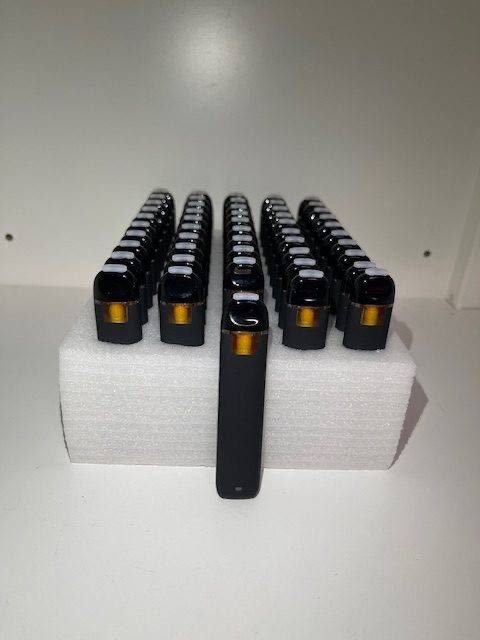
If you’re shopping the category — or just trying to understand it — you’ll run into three hardware terms constantly. A DMT vape is the general category: any battery-powered device that heats DMT liquid into inhalable vapor. The other two terms describe specific formats within it.
A DMT cart (cartridge) is a pre-filled tank of DMT vape liquid designed to screw onto a standard rechargeable vape battery — most commonly a 510-thread battery. The cartridge holds the liquid and the heating coil; the battery provides the power. When the cart is empty, you keep the battery and attach a new cart. It’s the modular, economical option.
A DMT disposable is an all-in-one unit: battery, coil, and pre-filled DMT liquid sealed in a single device that’s discarded when empty. No charging, no swapping parts, no maintenance — maximum convenience at the cost of more waste and a higher per-unit price.
The DMT itself is the same class of compound across all three formats; the differences are purely hardware, convenience, and cost structure. Disposables suit people who want zero setup; carts paired with a reusable battery suit anyone who’ll go through more than one.
What Are the Effects of DMT?
The short version: vaped DMT takes effect within seconds, peaks within a couple of minutes, and the intense phase lasts roughly 5–15 minutes — far shorter than LSD or psilocybin, but frequently described as more intense minute-for-minute. Commonly reported features include vivid immersive visuals, a sense of leaving ordinary reality entirely, encounters with seemingly autonomous entities, and radical distortion of time perception.
The experience varies enormously between individuals, and difficult experiences — panic, confusion, a sense of dying — are well documented. For a thorough, sober breakdown of effects, risks, tolerance, and safety considerations, read our dedicated guide: DMT effects guide
Is DMT Legal?
Under US federal law, DMT is a Schedule I controlled substance — illegal to manufacture, distribute, or possess nationwide. A few states (notably Colorado) have decriminalized personal possession, some cities have deprioritized enforcement, and narrow religious exemptions cover specific churches’ sacramental ayahuasca use. There is no legal commercial market for DMT products anywhere in the US. For the full state-by-state picture: Is DMT Legal?
Frequently Asked Questions
What is DMT?
DMT (N,N-dimethyltryptamine) is a naturally occurring psychedelic compound in the tryptamine family. When vaporized, it produces a brief but extremely intense psychedelic experience lasting roughly 5–15 minutes at peak.
What is in DMT?
Chemically, DMT is a single compound: N,N-dimethyltryptamine, structurally similar to serotonin. In vape products, DMT extract is suspended in a carrier liquid — formulations vary by manufacturer.
Why is DMT called the spirit molecule?
The nickname comes from Dr. Rick Strassman’s 2001 book DMT: The Spirit Molecule, about his 1990s clinical DMT research at the University of New Mexico, where volunteers repeatedly described entity encounters and otherworldly realms.
What’s the difference between a DMT cart and a DMT disposable?
A DMT cart is a pre-filled cartridge that attaches to a reusable vape battery (usually 510-thread) — you replace the cart, not the battery. A DMT disposable is an all-in-one sealed unit you discard when empty.
How long does a DMT vape experience last?
Onset is within seconds of inhalation, the intense phase lasts about 5–15 minutes, and most people return to baseline within roughly half an hour.
Is DMT the same as ayahuasca?
Not exactly. Ayahuasca is a ceremonial brew that combines DMT-containing plants with MAO-inhibiting plants, making the DMT orally active for hours. Vaped DMT is the isolated compound with a much shorter duration and no MAOI component.
Explore the Product
For full details on the Breath of Brahma DMT vape — hardware, specifications, and product information — see here: Breath of Brahma DMT vape.